Sapphic love, addiction, and hurricanes: Arielle Hebert on her debut poetry collection Bottom Feeders.
We recently had the privilege of getting access to an early copy of Bottom Feeders, Arielle Hebert’sd ebut poetry collection. Prior to our interview, I read through the collection twice, and now that we’re finally getting around to publishing the interview — I’ve got the itch to read it again.
As someone who grew up in Florida, the way Hebert captures the beauty and complexities of the state and how it impacts the characters is intoxicating. Bottom Feeders is the kind of poetry collection that truly creates a complete universe of its own, taking readers into the world of a sunburned sapphic romance marked by the unforgiving nature of the opioid epidemic that ravaged Florida in the 2000s.
We’re excited to share our discussion with Hebert on how Bottom Feeders was created, the intricacies of the story, and the inspiration behind her debut collection, so you can see for yourself why we loved Bottom Feeders so much.
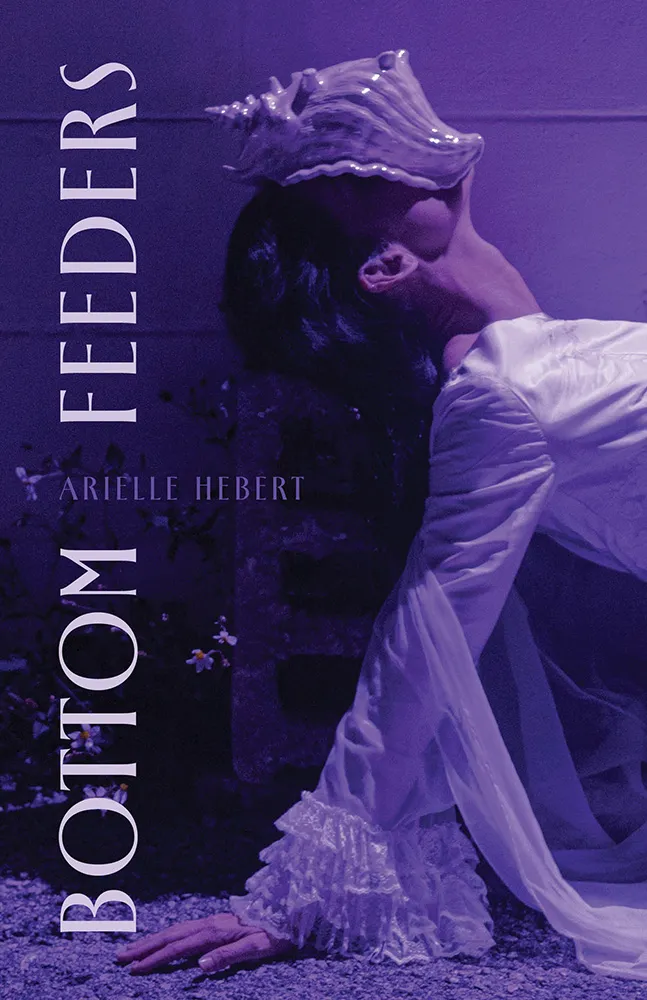
Bottom Feeders by Arielle Hebert
What were the beginnings of creating this collection like? How did it all start?
I drafted the first poems in grad school, between 2015 and 2017, a few years after I left Florida. There were a handful of Florida pieces in my thesis, and then I wrote the title poem, “Bottom Feeders.” It does a lot of scene-setting and provides a foundation for the relationship between the speaker and her girlfriend who is selling pills and other drugs to make ends meet, before she herself becomes addicted. It also describes a variety of characters from different socioeconomic backgrounds—from the working class to the wealthy—which captures the all-encompassing nature of the opioid crisis. That poem felt like the heart of something, so I started to arrange the bones and build a skeleton around that beating center.
What was the process like while creating Bottom Feeders? What were some key themes you wanted to explore? Are there any ideas, imagery, or motifs that you were surprised you kept coming back to?
In its early drafts, the book was too heavy. I had written about the hard things—the speaker’s girlfriend’s addiction, recovery, and attempted overdose. One of my mentors and early readers of this manuscript, Eduardo C. Corral, pointed out that readers also needed to know why the speaker loved this person to begin with. Why was it so hard to watch her succumb to addiction and cycle through recovery and relapse, and why was it so hard to ultimately let her go? I wrote myself a note that said, “I Promise Not to Leave the Good Days Out” and stuck it to my desk. Later, I used it as an on-ramp title for a poem cataloging some of those good days. That promise also spurred me to write about our friend group and Florida’s incredible wildlife and environments, which added more flesh and texture to the world of the book.
I was surprised how much I kept returning to Sarasota’s history as a circus town. It seemed anecdotal at first but turned out to be a foundational context for present-day issues in tourism, entertainment, wealth, and class. It also allowed me to write more surreal poems like “Magician’s Assistant,” which capture the almost dream-like quality of living in Florida.
Were there any poets that inspired you while creating this collection?
Natalie Diaz’s collection When My Brother Was an Aztec was hugely inspiring. Diaz’s poems about loving someone who is battling addiction ring so close to home for me, but there are also poems in the last section of the book about queer love that make my heart ache. It’s a book that I needed as a young queer woman/poet. (Thank you, Natalie.)
Do you have any favorite Floridian poets, musicians, or artists who you draw inspiration from?
So many! I love Caridad Moro-Gronlier’s poems. I have a deep appreciation for Sarah Gerard—particularly her book Sunshine State: Essays—Kristen Arnett, and Lauren Groff. A few Florida visual artists I love are Veronica Steiner, Anastasia Samoylova, and Selina Román. Román’s photograph “Refusal to Unpack” graces the cover of Bottom Feeders, and I’m obsessed with everything she makes. Nep is an incredible Florida girl singer-songwriter I am new to (shoutout to my publicist, Zoe, for showing me her music!).
I was so excited to read this collection, as a queer person from Florida. Your portrayal of Florida feels immaculate: banyan trees, the ocean, hurricanes, alligators, snakes, Publix, the humidity, and the juxtaposition of waterfront mansions and misfortune. How did you approach your portrayal of Florida? What do you want readers to understand about the setting, and how is it inspired from your own experience as a queer person growing up in Florida?
Thank you! It feels good to be seen/read/recognized by a fellow Florida queer <3. I was worried that people would read the book and think I hated Florida, when it’s really the opposite. I hope readers appreciate the scope of Florida’s natural beauty—its beaches and mangroves, swamps, palmetto and pine forests, and rainstorms—and how difficult it was to leave all that behind. I miss Florida every day. I wanted to convey that in my poems, but I was also grieving a place that didn’t always love me back. It was important to me to capture both the love I have for Florida and the grief and guilt I felt for leaving.
Do you have a favorite (or multiple) poem from this collection? Were there any that you’d been working on before you even knew it would become a part of Bottom Feeders?
I don’t know about a favorite poem, but the one I had the most fun writing was “Alligator Fight.” It’s an ode to feral teenage girls, surviving and even thriving on chaos, making the rules up as we went along. The commanding image of alligators fighting helped me to capture those girls’ fierce and fearless nature.
One of the earliest poems I wrote in grad school was “Codependence,” which was first published in Burrow Press’s Fantastic Floridas series under the title “We Go to the Beach During Her Withdrawals.” The “Etymology of” poems were written fairly early too. I’ve always loved studying the etymological roots of words, and when I started looking up the roots for words like “addiction” and “recovery,” I found so much to explore in the language we use for these experiences.
This collection deals with the effects of the opioid epidemic, and the experience of loving someone who is actively addicted. Florida was the epicenter of the epidemic, as one of the largest distributors of OxyContin in the country. You describe this in Phantasmagoroia, which is one of my favorites from Bottom Feeders:
“Every two hours there is an opioid overdose in Florida. Between 1999 and 2013, prescriptions of opioids increased by 400%. Pill Mills run by corrupt doctors didn’t bother to hide, made millions of dollars selling thousands of painkillers a day. Police said getting an opioid prescription was as easy as buying a cheeseburger at McDonald’s.”
The way you write the contrast of the beach vs. the physical effects of withdrawal in Codependence is also beautiful. Overall, the way you write about extremes of the setting, the extremes of being in love and facing addiction, is both mesmerizing, heartbreaking, and illuminating to readers who might be unaware of the cruel history of the opioid epidemic.
When you decided to write this story, what was important to you when portraying addiction? Was there any specific feeling that you wanted readers to understand? And is this a topic you’ve explored in your poetry before?
It was important to me not to villainize addicts or addiction. I wanted readers to understand the completely surrounding, inescapable nature of the opioid crisis in Florida in the 2000s. It’s not an exaggeration when I say almost everyone I knew was addicted to pills or selling them to get by. OxyContin was as commonplace as humidity or heat. Painkillers touched every aspect of our young lives and left a lasting mark. It’s a benign example, but even now, I won’t accept a prescription from the doctor for opioids to manage pain after medical procedures or surgeries. On the anniversaries of friends’ deaths, I am still swallowed by grief. Addiction is a topic that’s haunted my writing since high school, that continues to haunt.
Through your poetry, you often process life and relationships through the lens of natural phenomena. How does your relationship to the land, wildlife, and natural forces shape the way you process the chaos of the world?
I’ve always turned to nature to center myself. When I was a kid in Louisiana, if I wasn’t reading, I was outside exploring, looking at water bugs and crawfish in the creek, climbing trees, spending time with the horses or the cats. We moved to Florida when I was ten, and I was lucky we lived pretty close to the beach. Once I got my license at sixteen, I would drive over to Siesta or Turtle Beach for the sunset, to process the day, let my heels sink into the sand where the waves break. Being outside and paying attention to nature helps me feel more connected to the world, especially when I feel despair for it. I think in another life I would have been happy to work as a park ranger or a biologist.
The characters are very much at the mercy of the environment; with sunburns, drowning, currents, and hurricanes appearing throughout the collection. However, the environment is often described as a paradise, too. I felt like this was a beautiful parallel to a queer love story impacted by addiction. What were you trying to illuminate with these parallels? What are some tools you have learned from nature that help you move through the ebbs and flows without drowning?
For me, Florida is another person in the book. It’s a place with so much character and influence—it’s messy and contradictory and contains multitudes! It’s both a beautiful place and a place where tragedy has happened. I think I was just trying to illuminate the “both/and” nature of Florida, but also the nature of any home, how it shapes us for better and for worse.
I’m always learning hope and resilience from nature. Since moving to North Carolina, I especially have an appreciation for the seasons, for evidence of the passage of time (whereas in Florida, there’s one long summer and hurricane season). The seasons (and the tides, if we’re talking ebbs and flows) are a reminder that nothing lasts forever, that life is beautiful because it’s constantly changing.
In Bottom Feeders, you often cast yourself back in time through nostalgic vignettes as well as to alternate futures that could have been. Many of these possible futures become memories of their own.
What portals, past and present, are you fondest of revisiting over and over again. How do you alchemize impossible moments through your art? Do you have any personal rituals, such as the scene from For Protection, to revisit and reflect on difficult scenes from life?
I love the idea of possible futures becoming memories of their own! Many of the poems in this book are fueled by memories of the past that I’m haunted by. And the impossible can be another lens to look through at the past—what could have been, or what should have been. Going back to that time, when we were so young and had our whole lives ahead of us, I felt the need to write about the (im)possible futures or alternate paths, decisions that might have made things turn out differently. It was a space for wishful thinking and happier endings, to leave room for hope.
Is scab-picking a ritual? Once or twice a year, I look at old photos, calendars, notes, and journals from high school. I have a good cry. It can hurt to remember, but my worst fear is forgetting.
Are there any fictional sapphic love stories that inspire you? Were there any that inspired your characterization in Bottom Feeders?
None that inspired Bottom Feeders, at least not on a conscious level. But a few of my favorites are Fair Play by Tove Jansson, Le Fanu’s Carmilla, The Locked Tomb series by Tamsyn Muir, and the movie Portrait of a Lady on Fire (2019).
What was your favorite part about writing Bottom Feeders?
Despite the shadows cast over them, it was fun to dwell in these memories, to spend time with these former selves. In part, the book is an ode to the messy girls, testing our limits, dancing at parties, drinking too much, thriving on chaos. Even the hard parts were good for me to write, to archive that part of the past, to have a vessel to carry some of the heaviness, so I could let it go, or at least set it down for a while.
What advice would you give to aspiring poets who are hoping to share their work and get published someday?
Keep going! Whatever you do, just don’t give up. Rejection is hard, and the near-misses are even harder, but you have to keep putting your work out there for consideration. Submit as much and as often as you’re able to and can afford. Start with a manageable monthly goal—maybe 3 submissions per month—and stick to it. All the while, keep writing, keep revising. Building a portfolio of accepted poems takes time, as does writing poems you’re proud of. Enjoy the work, find poetry in everything, and remember why you’re making art in the first place. Oh, and you don’t need AI, for anything.
Pre-order Bottom Feeders:
♡