Preserving History in Palestine: Eyes on Heritage
We first encountered Eyes on Heritage through a collection of photos. We were instantly captivated and in awe of their work, risking their lives in the midst of a genocide to preserve Palestinian history and heritage through the careful restoration of rare books and manuscripts — some of them centuries old.
We reached out to learn more about their mission, the delicate (and technical) process of restoration, and the dire importance of preserving Palestine’s written history for generations to come.
Here’s their introduction, in their words:
“Before answering the questions, we would first like to introduce Eyes on Heritage. Eyes on Heritage is an Institution, non-profit research institution dedicated to collecting, preserving, and archiving Palestinian heritage, including manuscripts, rare books, and historical documents. Since its establishment in 2009, the institution has also specialized in the restoration of rare manuscripts. Our vision is rooted in spreading awareness of both tangible and intangible heritage and making it accessible to future generations. We believe that voluntary work in protecting documentary and manuscript heritage is an essential part of safeguarding Palestinian history and identity.”
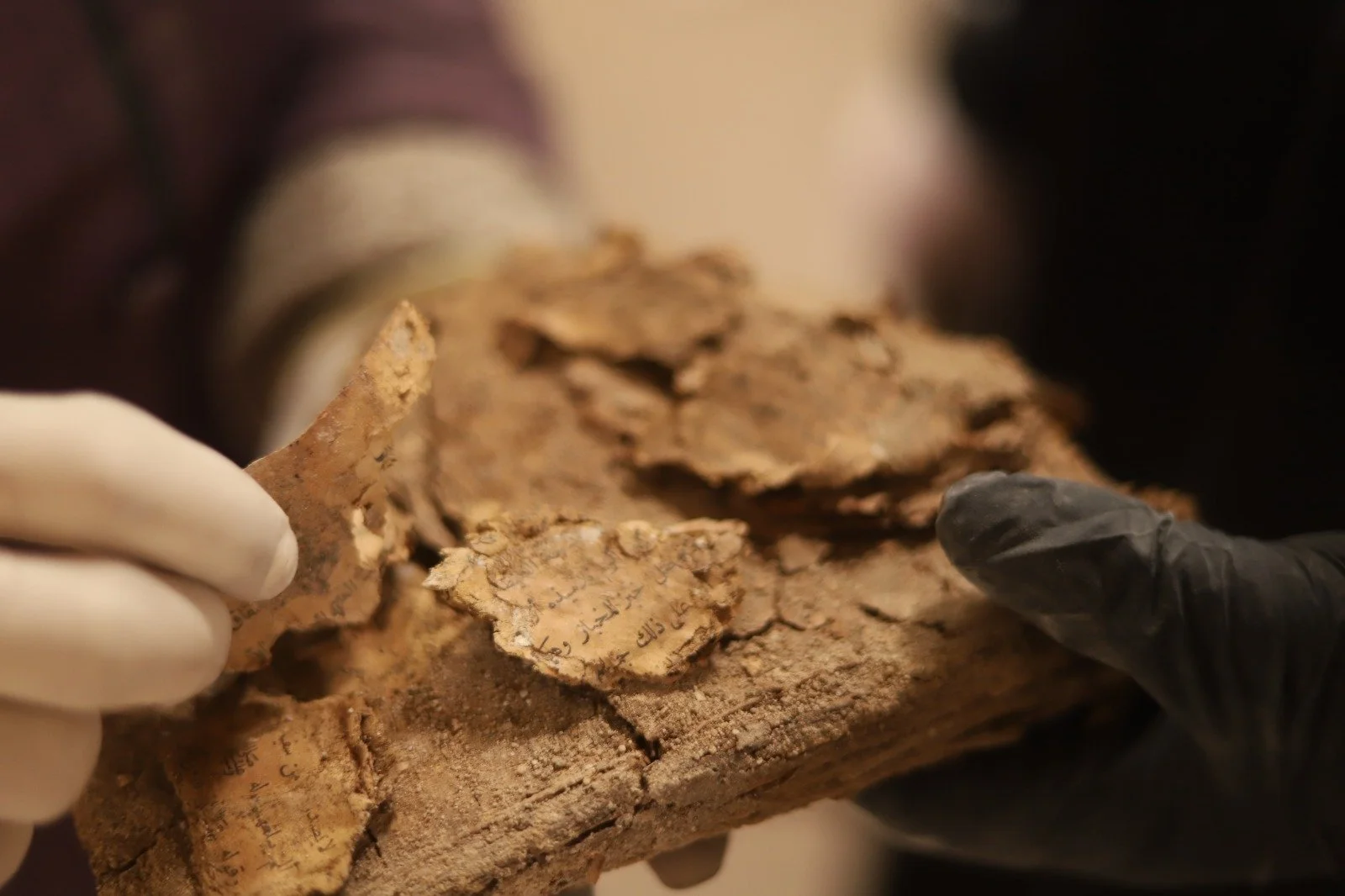
The Eyes on Heritage team carries out a volunteer initiative to rescue the oldest historical library in Gaza City, the Great Omari Mosque Library. Photo Courtesy of Eyes on Heritage
What kinds of books do you work to preserve? Do you have any favorites?
“Our team works to rescue and preserve every manuscript and rare book that can still be saved amid the repeated wars on Gaza. Following the devastating genocide that targeted not only people and buildings, but also paper and memory itself, our institution has suffered immense losses. Eyes on Heritage was completely destroyed during the 2014 war, and we lost members of our team. The institution was targeted again in September 2025 during the current war. The historic collection of the Great Omari Mosque Library was also bombed more than three times, leaving many manuscripts, archives, and collections buried beneath the rubble to this day. We still hope to recover them, but rescue operations require significant financial resources at a time when every basic necessity of life is lacking in the devastated city.
As for rare books, we believe every book is a document that carries the thought, spirit, and legacy of its author. Among the materials we value most are the rare books that were printed and published in Palestine before 1948. Palestine and its scholars were once an important source of cultural and intellectual influence across the Arab world, especially throughout the Levant.
Today, however, this heritage is being systematically erased in an attempt to destroy that legacy of knowledge and cultural flourishing.”
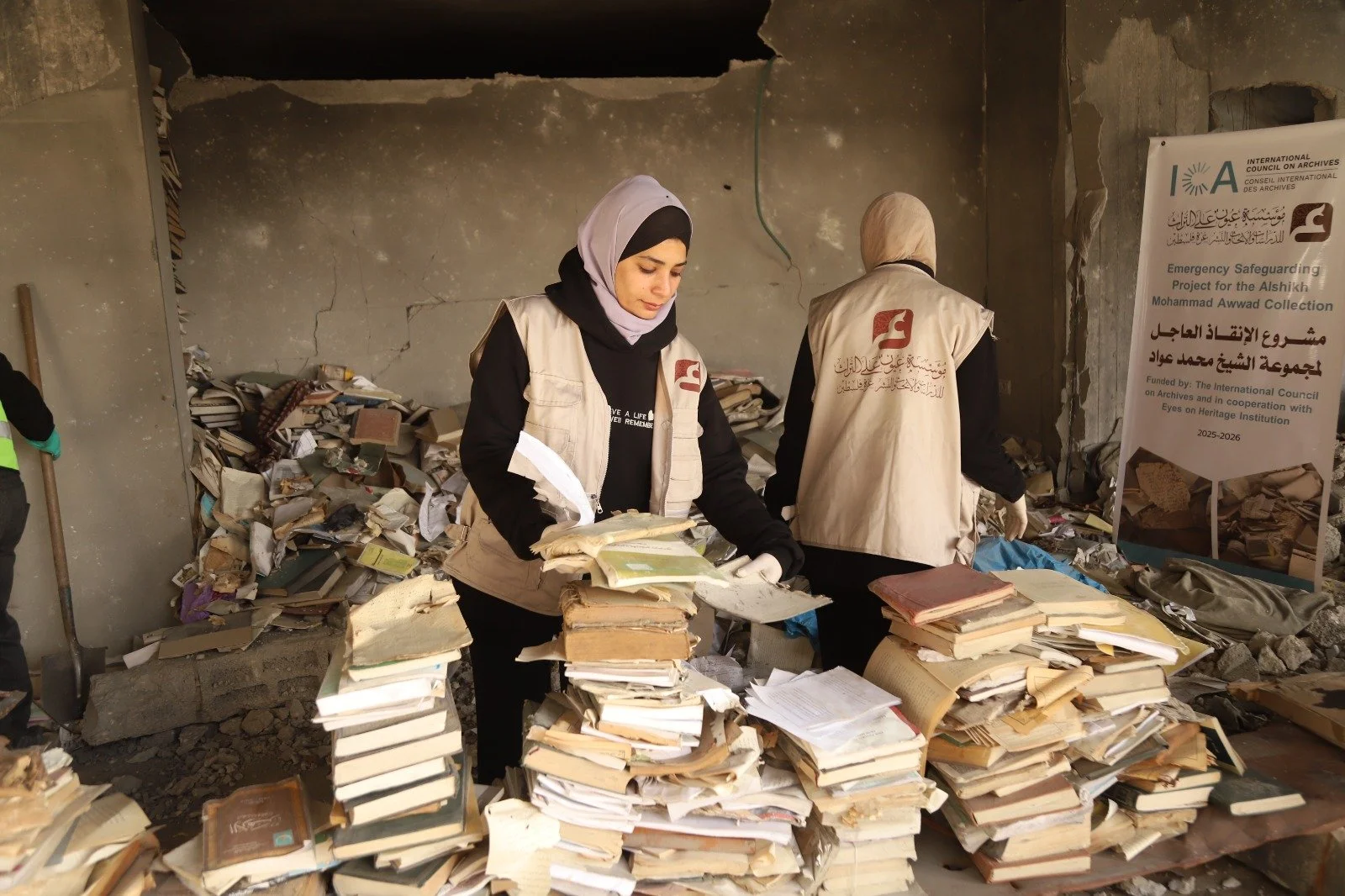
Rescue of the Sheikh Mohammed Awad Collection, supported by the International Council on Archives (ICA). Photo courtesy of Eyes on Heritage
What does preserving a book require?
“Preserving books and manuscripts requires many technical procedures and preventive conservation measures. Preventive conservation focuses on reducing the causes of deterioration before damage occurs by creating a stable and relatively safe storage environment.
This includes controlling temperature and humidity levels, minimizing direct exposure to light and ultraviolet rays, using acid-free materials and protective covers, monitoring insects and Mold, and ensuring safe handling and transportation practices for manuscripts. For example, we are in urgent need of medical alcohol, which is essential for cleaning manuscripts and books affected by mold and insects.
Yet obtaining it has become an exhausting challenge. Finding even small amounts is nearly impossible, and when we do manage to secure some, the quantity is barely enough to save a single book. This is largely due to restrictions that prevent sufficient medical and humanitarian supplies from entering Gaza.”
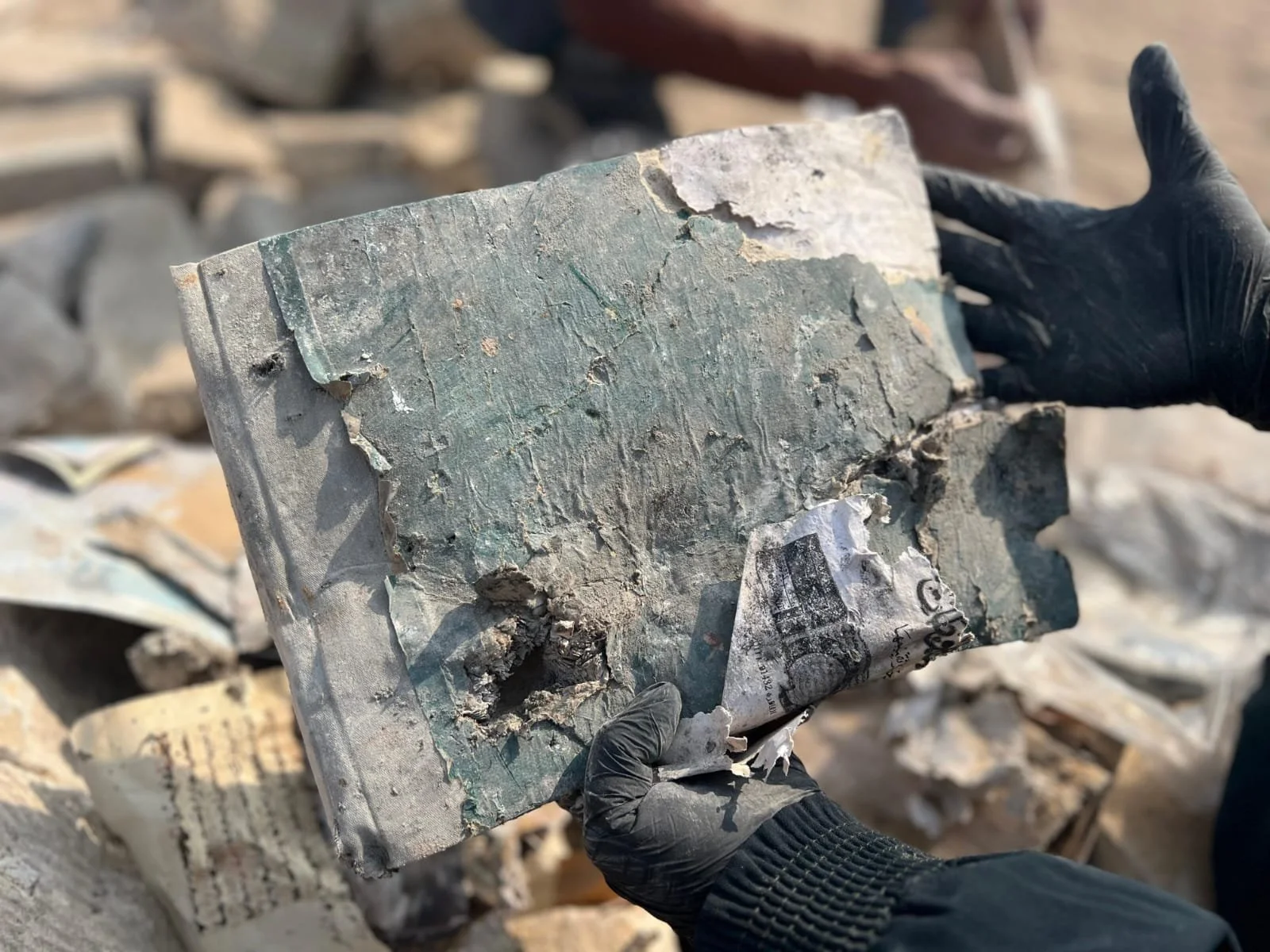
A book recovered from beneath the rubble of Al-Ghafri Tower, the headquarters of Eyes on Heritage Foundation. Photo courtesy of Eyes on Heritage
Can you give us a glimpse into a day in the life of an archivist?
“A day in the life of an archivist during war and genocide becomes far more than quiet technical work — it turns into a daily mission to rescue memory and identity. The day often begins with checking storage areas and assessing the condition of documents and manuscripts after airstrikes, power outages, water leaks, or rodent infestations.
We then try to move the most fragile materials to places that are at least relatively safer, even if only temporarily. Archivists in these conditions document damage, dry water-damaged papers, remove dust and debris, and continue digitization efforts whenever electricity or internet access becomes available, because sometimes the digital copy may become the only surviving version of an archive. At the same time, archivists live under immense psychological pressure, because they are not simply protecting papers, they are trying to save the memory of an entire society threatened with erasure.
In times of war, archiving itself becomes an act of cultural and human resistance. The archivist becomes both a witness and a guardian of memory in the face of destruction and genocide.”
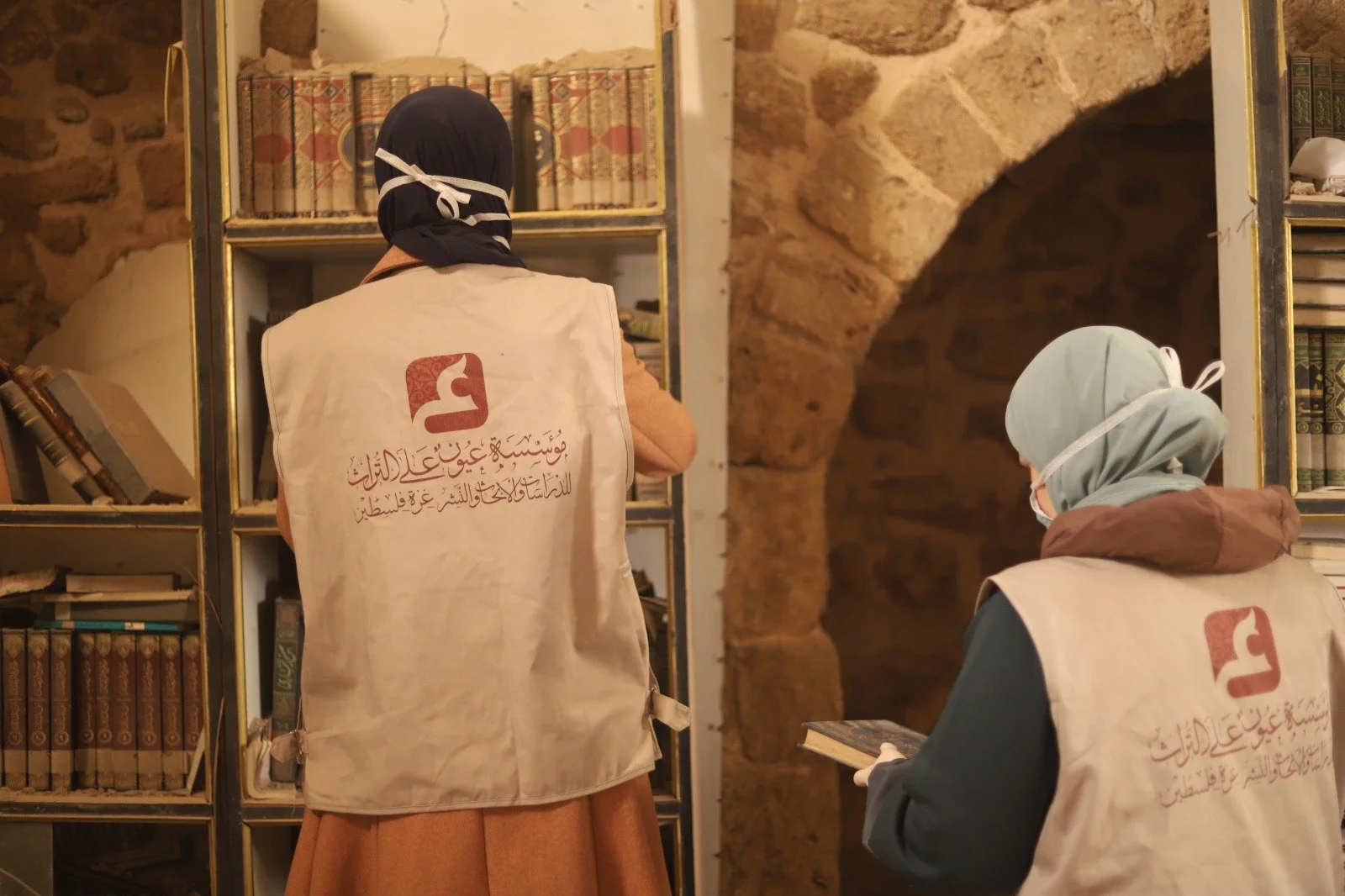
The Eyes on Heritage team carries out a volunteer initiative to rescue the oldest historical library in Gaza City, the Great Omari Mosque Library. Photo courtesy of Eyes on Heritage
Have there been any memorable moments in your work that still stay with you?
“There have been many powerful moments that remain deeply engraved in our memories. Whenever we discover a manuscript or book that we believed had lost its last surviving physical copy, we experience an overwhelming sense of achievement and joy. One example was when our team found the book Historic Mosques, written by Dr. Abdel Latif Abu Hashim, the historian of Gaza City. We had lost all of our physical copies of this book, yet it was extremely important to us because it contained photographs of some of Gaza’s most historic mosques — many of which were destroyed during the recent war. The book itself became a visual document preserving the memory of those mosques. When we found it again, it felt as though we had rescued a priceless treasure.”
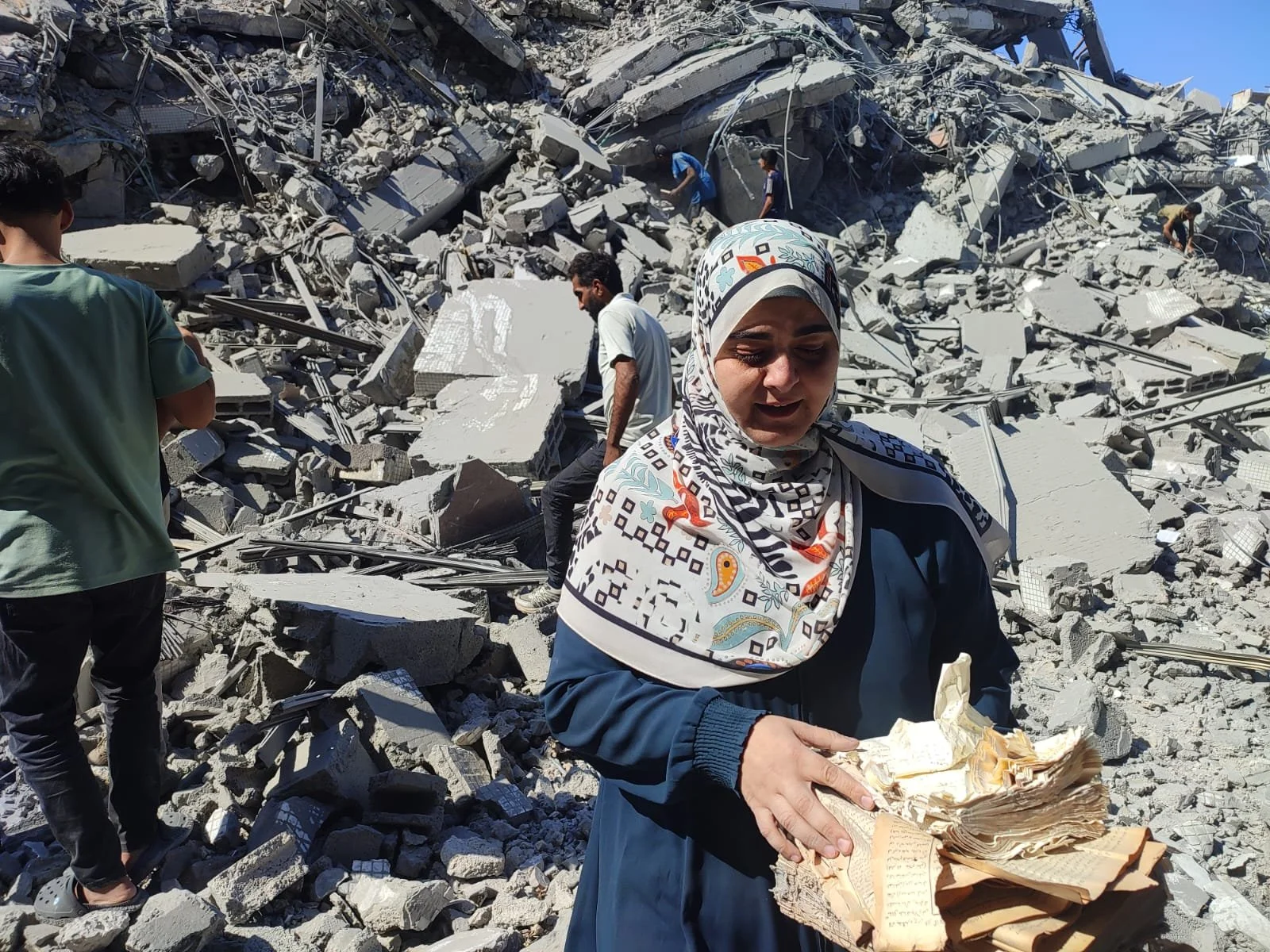
Executive Director Ms. Haneen Al-Asmi stands in front of the ruins of Al-Ghafri Tower, following the destruction of the organization’s headquarters. Photo Courtesy of Eyes on Heritage
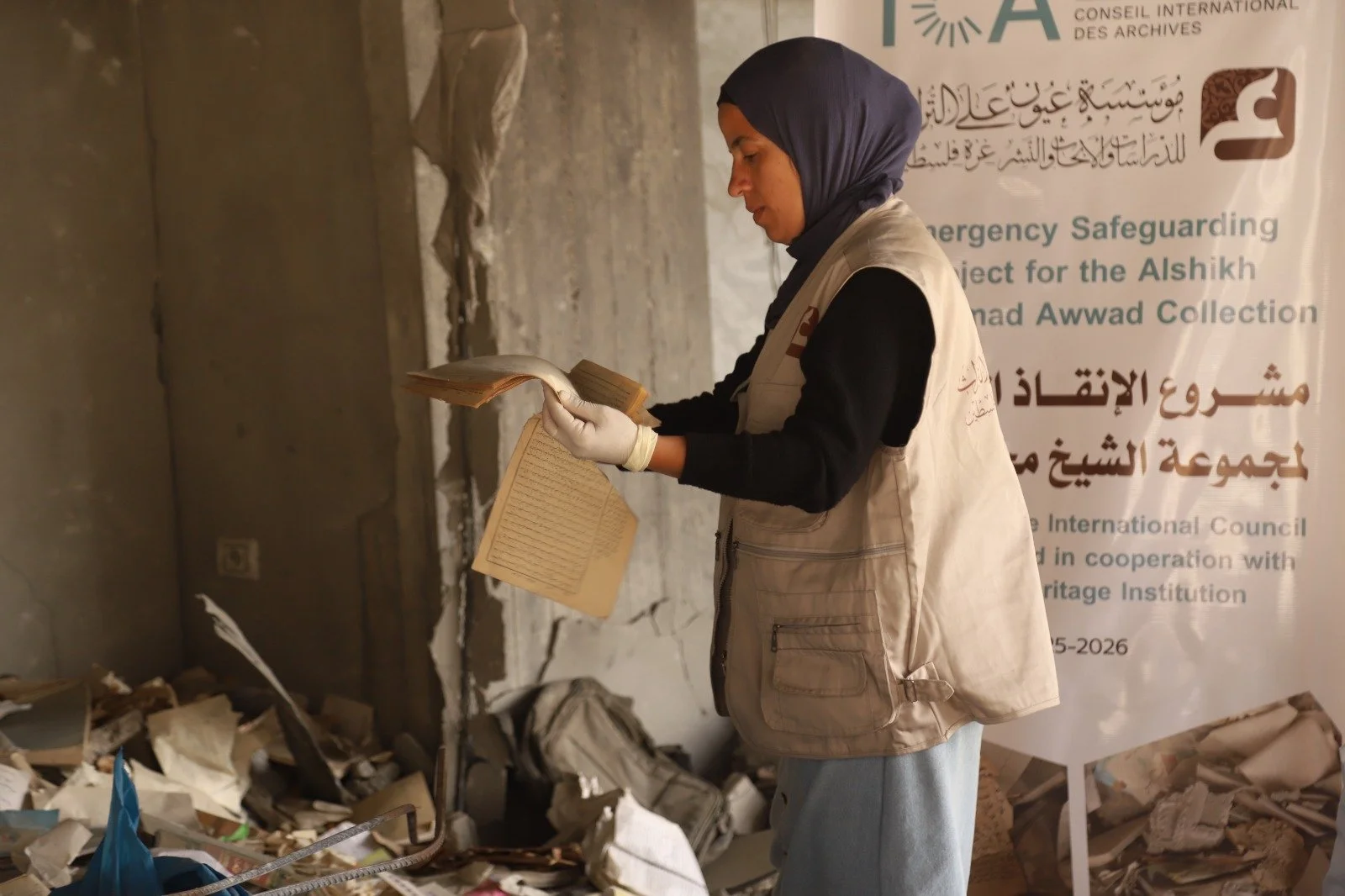
Ranem Musa Shaaban continuing the mission of rescuing surviving libraries in Gaza City. Photo courtesy of Eyes on Heritage
What would you like the world to remember about you — the archivists living through this moment? Tell us your story.
“We want the world to remember that archivists and manuscript keepers during wartime were not simply guardians of paper, but guardians of an entire people’s memory. We worked amid fear, death, and rubble to save whatever manuscripts, photographs, records, and documents we could, because we believed that the loss of memory is no less devastating than the loss of people and homes. Some of the most difficult moments involved emergency rescue operations for manuscripts threatened by bombing, fire, or humidity. With almost no proper materials available, we carried out manual conservation efforts ourselves — cleaning, drying, and protecting the manuscripts using the most basic tools possible, all under extremely harsh conditions and constant electricity and communication outages. For us, saving manuscripts was an act of loyalty to history itself, so that Gaza would remain present in human consciousness despite every attempt to erase it. As for our story: since 2009, the Eyes on Heritage team has worked in Gaza as a volunteer cultural initiative led by Gaza historian Abdel Latif Abu Hashim. The initiative was founded on the belief that protecting Palestinian memory is just as important as protecting people and places.
A group of young women joined together around the idea of rescuing Gaza’s written heritage by collecting manuscripts, documents, photographs, and rare books that were at risk of disappearing from old homes, private libraries, and mosques. Over the years, the team worked under difficult conditions, moving between neighbourhoods and libraries to document, restore, and digitize as much of Gaza’s cultural archive as possible. Inside a small headquarters on the Gaza coast, thousands of pages, photographs, magazines, and rare periodicals accumulated — some dating back to the late Ottoman era, others documenting Palestinian life before the Nakba of 1948. This was never simply an archival project. It was an attempt to protect the memory of an entire city from being forgotten. When war broke out and the team’s headquarters was destroyed, the members found themselves facing a new mission: rescuing what remained of the archive from beneath the rubble. Amid dust and shattered concrete, they continued searching for scattered manuscripts and documents, believing that every rescued page meant saving another piece of Gaza’s story and memory. In this way, Eyes on Heritage evolved from a youth initiative into a living national institution: a testimony to resistance against forgetting, and to the enduring capacity of culture and memory to survive even amid genocide.”
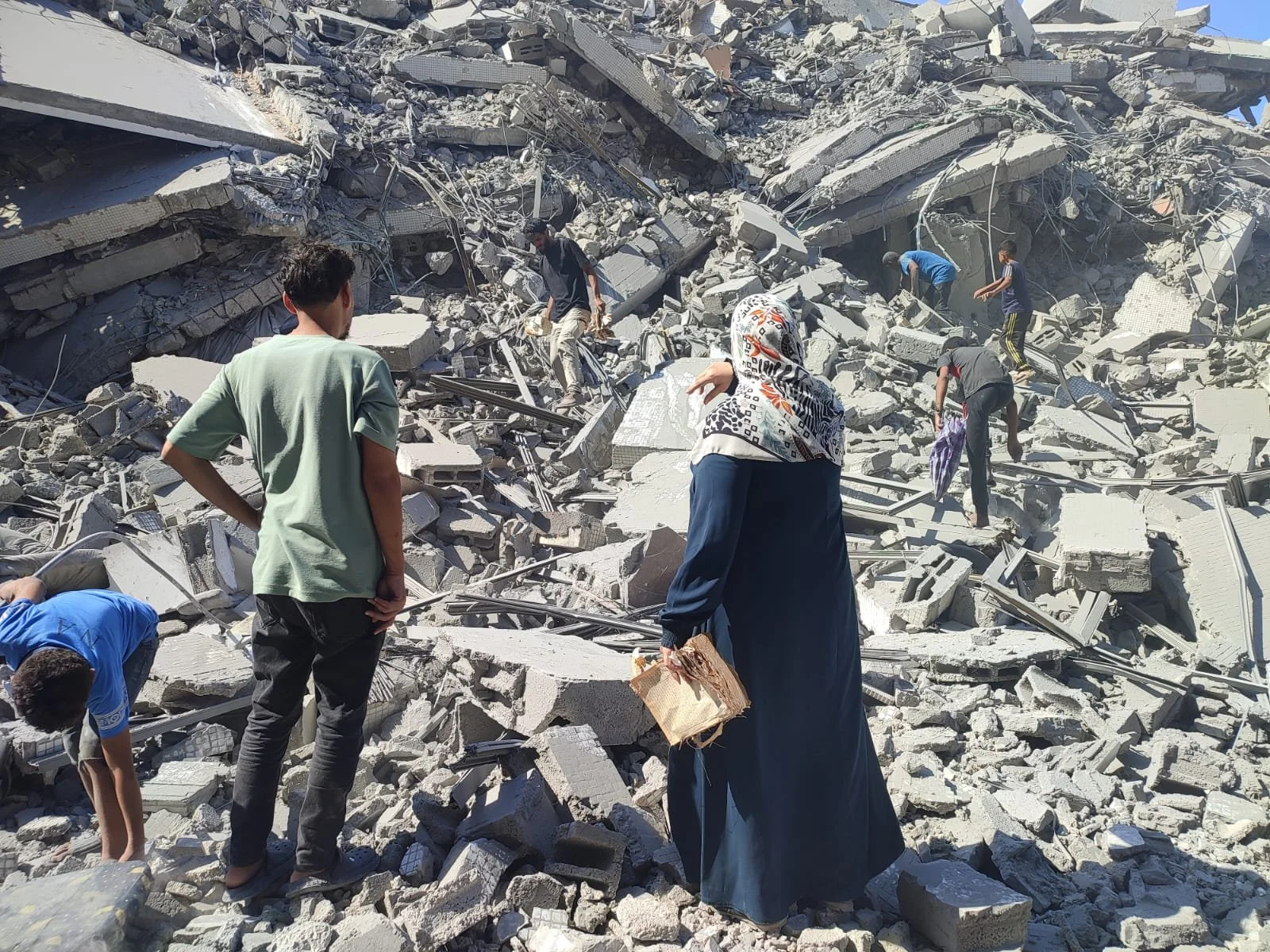
Executive Director Ms. Haneen Al-Asmi stands in front of the ruins of Al-Ghafri Tower, following the destruction of the organization’s headquarters. Photo courtesy of Eyes on Heritage
Is there anything else you would like people to know about your mission?
“We want the world to understand that our mission is to protect what remains of our history, memory, and cultural heritage, and to pass it on to future generations. Every book, manuscript, or document we manage to save means that we have preserved a part of our collective story and prevented another page of Gaza and Palestine’s history from disappearing forever. What we are facing today is not only a threat to buildings or collections, but a real threat to the memory of an entire people.
Protecting the remaining manuscripts, archives, and historical records has therefore become a responsibility for every honourable human being, because these materials could disappear forever at any moment if proper preservation, documentation, and archiving support are not provided. Despite the darkness surrounding the city, we continue this difficult mission. But the survival of this work also depends on solidarity from people around the world — by sharing our story, helping raise awareness about what we do, supporting rescue and preservation efforts, or simply speaking about this experience and carrying it to others. Every voice that stands with us, and every act of attention given to this heritage, helps protect our history from erasure and gives memory a chance to remain alive.”
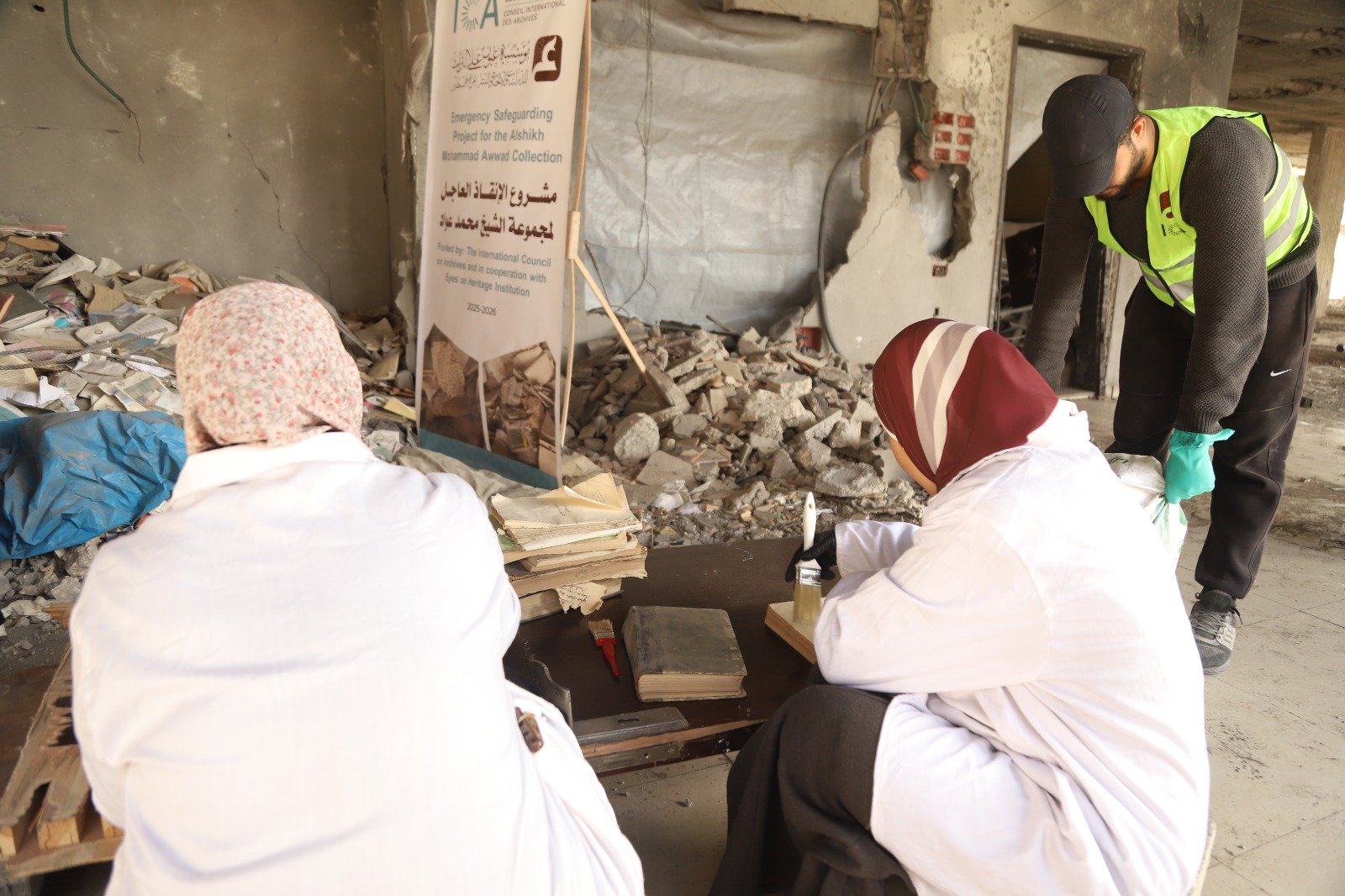
Rescue of the Sheikh Mohammed Awad Collection, supported by the International Council on Archives (ICA). Photo courtesy of Eyes on Heritage
Thank you to the Eyes on Heritage team for sharing the heart and soul of their mission, and for the labor required to ensure Palestinian history is never forgotten.
Find Eyes on Heritage on Instagram ♡